
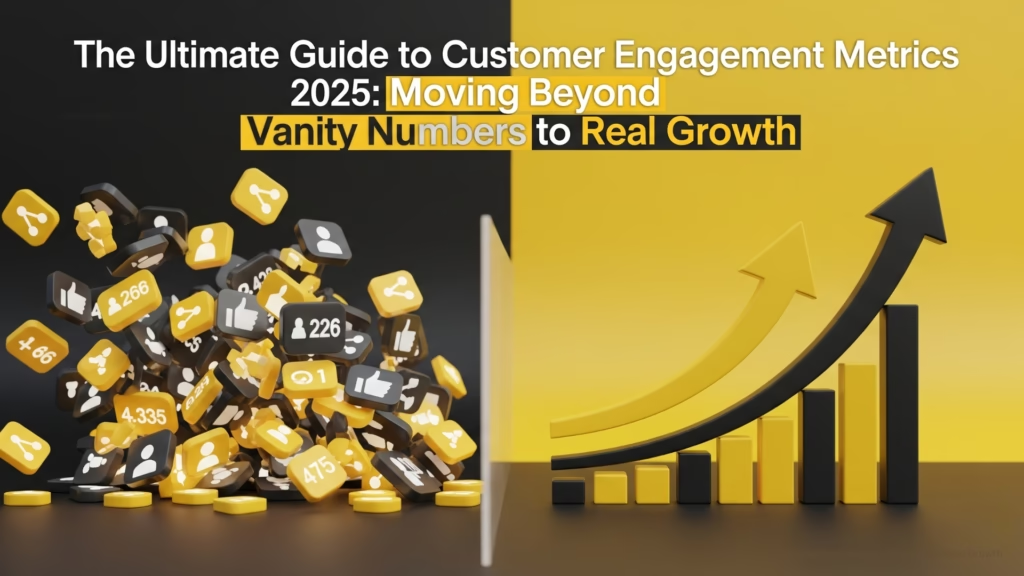
In the bustling, hyper-competitive world of digital marketing, it’s easy to get lost in a sea of data. We chase clicks, celebrate likes, and obsess over page views. But ask yourself a critical question: are these numbers truly telling you how your customers feel about your brand? Are they measuring the strength of your relationship with the people who matter most?
The answer, often, is no. This is where the true power of Customer Engagement Metrics 2025 comes into play. Forget about measures that look impressive on paper but don’t move the needle for your bottom line. Real Customer Engagement Metrics 2026 act as the vital signs of your brand’s connection with its audience. They reveal not just who is watching, but who is listening, interacting, trusting, and ultimately, investing in you.
This definitive guide will demystify the world of Customer Engagement Metrics 2025. We will move beyond the surface level and dive deep into the key performance indicators (KPIs) that actually matter. You will learn what to track, why it’s important, how to measure it, and most importantly, how to use that data to drive long-term growth. Mastering Customer Engagement Metrics 2025 is the single biggest shift you can make to transform from being just a business that sells to a thriving community that lasts.
What Are Customer Engagement Metrics, Really? (And Why They Are Your #1 Priority)
Let’s start with a simple definition.
Customer engagement metrics 2025 are a group of measurable indicators that show how much a user interacts, gets involved with, and connects with your business across several touchpoints. Unlike passive metrics (like impressions), customer engagement metrics 2025 require an active participant—the customer.
Think of it like a party. Impressions are the number of people who received an invitation. Clicks are the number who showed up at the door. But customer engagement metrics 2025 are the ones who are actually on the dance floor, laughing, talking, and enjoying the drinks. They are having an experience.
Why are these customer engagement metrics 2025 so critical?
- They Predict Customer Loyalty: An engaged customer is not a passive buyer. They are a fan, an advocate. They are far more likely to choose you again over a competitor.
- They Drive Long-Term Revenue: Acquiring a new customer can cost five times more than retaining an existing one. Engaged customers have a higher lifetime value (LTV), buy more frequently, and are more likely to try your new products.
- They Provide Invaluable Feedback: These metrics are a direct line into what your customers want, like, and dislike. They highlight friction points in your user experience and reveal opportunities for improvement.
- They Fuel Organic Growth: Highly engaged customers become your brand evangelists. They leave positive reviews, refer friends and family, and create user-generated content—the most powerful marketing of all.
- They Offer a Competitive Advantage: In a world of similar products and services, a superior customer experience—measured by robust customer engagement metrics 2025—is the ultimate differentiator.
If you don’t pay attention to these client engagement KPIs, you’re flying blind. You might see sales, but you won’t understand the “why” behind them, making it impossible to replicate success consistently.
The Framework: Mapping Metrics to the Customer Journey.
You can’t measure everything at once. The most effective approach is to align your customer engagement metrics 2025 with the different stages of the customer journey: Awareness, Consideration, Conversion, Retention, and Advocacy.
This allows you to see how effectively you’re moving users from one stage to the next and identify exactly where people are dropping off.
[Diagram/Placeholder for a visual funnel]
Awareness, Conversion, Deliberation, Advocacy, and Retention
With corresponding metrics flowing through each stage
Let’s break down the essential customer engagement metrics 2025 for each stage.
Stage 1: Awareness Metrics – The First Handshake

This is where prospective buyers initially learn about your company. The goal here is to grab attention and make a positive first impression. The key customer engagement metrics 2025 here measure initial interest.
1. Click-Through Rate (CTR)
- What it is: The percentage of people who click on a specific link out of the total number who saw it (e.g., in an email, ad, or search result).
- Why it matters: It’s the first sign of engagement. A high CTR means your message is relevant and compelling enough to prompt action. It directly measures the effectiveness of your headlines, ad copy, and subject lines.
- How to compute: (Total Impressions / Total Clicks) times 100
- How to improve: A/B test your headlines, use strong verbs, create a sense of urgency or curiosity, and ensure your messaging aligns perfectly with your target audience’s intent.
2. Bounce Rate
- What it is: The percentage of visitors who land on a page on your website and then leave without viewing any other pages.
- Why it matters: A high bounce rate is a major red flag. It indicates that while your initial message (e.g., the ad) worked, the landing page did not meet the user’s expectation. The content might be irrelevant, the page might load slowly, or the design might be off-putting.
- How to calculate: (Total Single-page visits / Total Entries) x 100 (Calculated automatically in Google Analytics).
- How to improve: Ensure landing page content matches ad copy perfectly. Improve page load speed. Simplify design and have a clear, compelling call-to-action (CTA).
3. Social Media Engagement Rate
- What it is: This goes far beyond likes. It’s a composite metric that measures the total interactions (likes, comments, shares, saves) relative to your total followers or reach.
- Why it matters: It measures how compelling your social content truly is. Comments and shares are much stronger signals of engagement than passive likes.
- How to calculate: (Total Engagements on a Post / Total Followers) x 100. Or, for a more accurate view: (Total Engagements / Total Reach) x 100.
- How to improve: Create content that sparks conversation (ask questions!), use high-quality visuals, leverage video, and engage with every comment you receive.
Stage 2: Consideration & Conversion Metrics – Building Trust and Sealing the Deal
Now, users are evaluating you. They’re on your website, reading your blog, comparing products. The customer engagement metrics 2025 here measure depth of interest and the effectiveness of your persuasion.
4. Average Session Duration
- What it is: The average amount of time a user spends on your site during a single session.
- Why it matters: Time is a precious commodity. If people are spending it on your site, it means they find your content valuable, interesting, or useful. It’s a core customer engagement metrics 2025 for content quality.
- How to calculate: Total Duration of All Sessions / Number of Sessions (in Google Analytics).
- How to improve: Create long-form, comprehensive content, use internal linking to keep users exploring, and embed engaging videos or interactive elements.
5. Pages Per Session
- What it is: The average number of pages a user views during a single session on your site.
- Why it matters: This indicates how effective your website is at guiding users through a journey. A high number suggests compelling navigation, related content suggestions, and an intuitive site structure.
- How to calculate: Total Pageviews / Total Sessions.
- How to improve: Use clear navigation menus, add “related posts” or “you may also like” sections at the end of articles, and create topic clusters that naturally link to each other.
6. Conversion Rate (CR)
- What it is: The percentage of users who complete a desired action (a conversion). This could be making a purchase, signing up for a newsletter, downloading an e book, or requesting a demo.
- Why it matters: This is the ultimate customer engagement metrics 2025 for the conversion stage. It directly measures the effectiveness of your website and content at turning visitors into leads or customers.
- How to calculate: (Number of Conversions / Total Visitors) x 100
- How to improve: Simplify your checkout process, remove form fields, strengthen your value proposition, and use trust signals (reviews, security badges).
7. Email Open Rate & Click-to-Open Rate (CTOR)
- What they are:
- Open Rate: The percentage of subscribers who open a given email.
- Click-to-Open Rate (CTOR): The percentage of people who clicked on a link out of those who opened the email.
- Why they matter: The open rate measures the power of your subject line and sender name. The CTOR, however, is a purer customer engagement metrics 2025—it measures how compelling your email content was to the people who actually saw it.
- How to calculate:
- Open Rate: (Opened/Delivered Emails) × 100
- CTOR: (Unique Clicks / Unique Opens) x 100
- How to improve: Write intriguing, non-spammy subject lines. Personalize content. Ensure your email provides clear value and has prominent, relevant CTAs.
Stage 3: Retention & Loyalty Metrics – The Art of Keeping Customers
Acquiring a customer is expensive; keeping them is profitable. This stage is all about nurturing existing relationships. The customer engagement metrics 2025 here are the most telling indicators of long-term health.
8. Customer Retention Rate (CRR)
- What it is: The percentage of your existing customers who remain customers over a given period (e.g., a month or a year).
- Why it matters: It costs far less to retain a customer than to acquire a new one. A high retention rate is a powerful sign of product-market fit, customer satisfaction, and effective onboarding and support.
- How to calculate: [(# of Customers at End of Period – # of New Customers During Period) / # of Customers at Start of Period] x 100
- How to improve: Implement a stellar onboarding process, provide proactive customer support, and create loyalty programs.
9. Customer Lifetime Value (CLV or LTV)
- What it is: The total predicted revenue a business can expect to earn from a single customer account throughout their entire relationship.
- Why it matters: This is the king of all customer engagement metrics 2025 . It tells you the long-term value of keeping a customer engaged. It helps you make informed decisions about how much to spend on acquisition and retention.
- How to calculate (Simplified): (Average Order Value) x (Number of Repeat Purchases) x (Average Customer Lifespan)
- How to improve: Increase engagement to drive repeat purchases, upsell and cross-sell relevant products, and create programs that increase the “lifespan” of a customer.
10. Repeat Purchase Rate
- What it is: The percentage of your customers who have purchased from you more than once.
- Why it matters: For e-commerce and SaaS businesses, this is a direct measure of customer satisfaction and product stickiness. It shows that your product delivers value worth coming back for.
- How to calculate: (Number of Returning Customers / Total Number of Customers) x 100
- How to improve: Implement a post-purchase email sequence, offer subscriptions for consumable goods, and use personalized recommendations.
Stage 4: Advocacy Metrics – Turning Customers into Your Marketing Team
This is the pinnacle of customer engagement. When customers love you so much they market for you, for free. Tracking these customer engagement metrics 2025 shows you’ve built a true community.
12. Viral Coefficient
- What it is: A measure of how many new users your existing users refer to your product. A coefficient above 1.0 indicates exponential growth.
- Why it matters: It quantifies the power of word-of-mouth and referral programs. It’s the ultimate growth customer engagement metrics 2025.
- How to calculate: (Number of Invites Sent by Users x Conversion Rate of Invites) / Total Number of Users
- How to improve: Create a seamless, incentivized referral program. Build a product that is so good people naturally want to share it.
13. User-Generated Content (UGC) Volume
- What it is: The amount of content—reviews, social media posts, photos, videos, blog posts—created by your customers about your brand.
- Why it matters: UGC is social proof at its most authentic. It’s more trusted than branded content and acts as powerful social validation.
- How to calculate: Track the number of posts using your branded hashtag, mentions of your brand, and reviews posted on your site or third-party platforms.
- How to improve: Run contests that encourage content creation, feature user content on your own channels, and simply ask happy customers for a review.
How to Implement a Strategy for Tracking Customer Engagement Metrics 2025
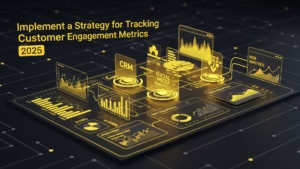
Collecting data is useless without a plan. Here’s how to build a strategy around these customer engagement metrics 2025.
Step 1: Set Clear Goals.
What are you trying to achieve? Brand awareness? Lead generation? Customer retention? Your goals will determine which customer engagement metrics 2025 are most important to you. Don’t try to track all 37 at once. Start with 3-5 that align directly with your current business objectives.
Step 2: Choose Your Tools.
You need the right technology to track these customer engagement metrics 2025 effectively.
- Google Analytics: Essential for website metrics (Bounce Rate, Session Duration, Pages/Session, Conversion Rate).
- Social Media Analytics: Native platform insights (Facebook Insights, Twitter Analytics, etc.) for social engagement rates.
- Email Marketing Platform: (Mailchimp, Klaviyo , etc.) for open rates, CTR, and CTOR.
- CRM Software: (HubSpot, Salesforce, etc.) for managing customer data, tracking NPS surveys, and calculating CLV.
- Specialized Tools: For deeper dives (e.g., Hotjar for session recordings, Delighted for NPS surveys).
Step 3: Establish a Baseline and Benchmark.
Before you start making changes, measure your current performance for your chosen customer engagement metrics 2025. This is your baseline. Also, research industry benchmarks to understand what “good” looks like for your sector.
Step 4: Analyze, Hypothesize, and Test.
Don’t just collect data—interrogate it.
- Analyze: Why is our bounce rate so high on the blog? Why did that specific email have a 50% CTOR?
- Hypothesize: “I think the bounce rate is high because the page load time is slow.” or “I think the email had a high CTOR because we used a personalized subject line and a single, clear CTA.”
- Test: Run an A/B test. Create a faster-loading version of the page. Send another email with the same winning formula to a different segment.
Step 5: Report and Refine.
Create regular reports (weekly, monthly, quarterly) that focus on these key customer engagement metrics 2025 . Share them with your team. Use the insights to inform your content strategy, product development, and customer service policies. This is a continuous cycle of improvement.
Common Pitfalls to Avoid
- Tracking Vanity Metrics: Don’t celebrate a follower count if your engagement rate is 0.5%.
- Looking at Metrics in Isolation: A high pages/session is great, but if those pages are all your “Contact Us” and “Cancel Subscription” pages, it’s a bad sign. Always view metrics in context.
- Not Segmenting Your Data: Your customer engagement metrics 2025 will look different for new vs. returning visitors, for different age demographics, or for users from different traffic sources. Segment your audience to get truly actionable insights.
- Ignoring Qualitative Data: Numbers tell you what is happening, but they rarely tell you why. Always supplement your quantitative customer engagement metrics with qualitative data: read customer comments, conduct user surveys, and talk to your support team.
Conclusion: From Data to Meaningful Relationships
In the end, customer engagement metrics 2025 are not about numbers on a dashboard. They are a proxy for human emotion and behavior. They are the digital heartbeat of your relationship with your audience. By shifting your focus from superficial analytics to these deep, meaningful customer engagement metrics 2025, you stop being a faceless corporation and start becoming a brand that people know, like, and trust.
Mastering this suite of customer engagement metrics 2025 allows you to build a business that is not just profitable, but also resilient and beloved. It’s a long-term game, but the payoff—a dedicated community of loyal customers who drive your growth for you—is the only metric that truly matters. Start today. Choose one metric from this guide, measure it, and take one action to improve it. That’s how the journey to mastering customer engagement metrics 2025 begins.
Author : Anas Malik